State fights to reclaim unlawfully occupied land used for holiday homes and restaurants
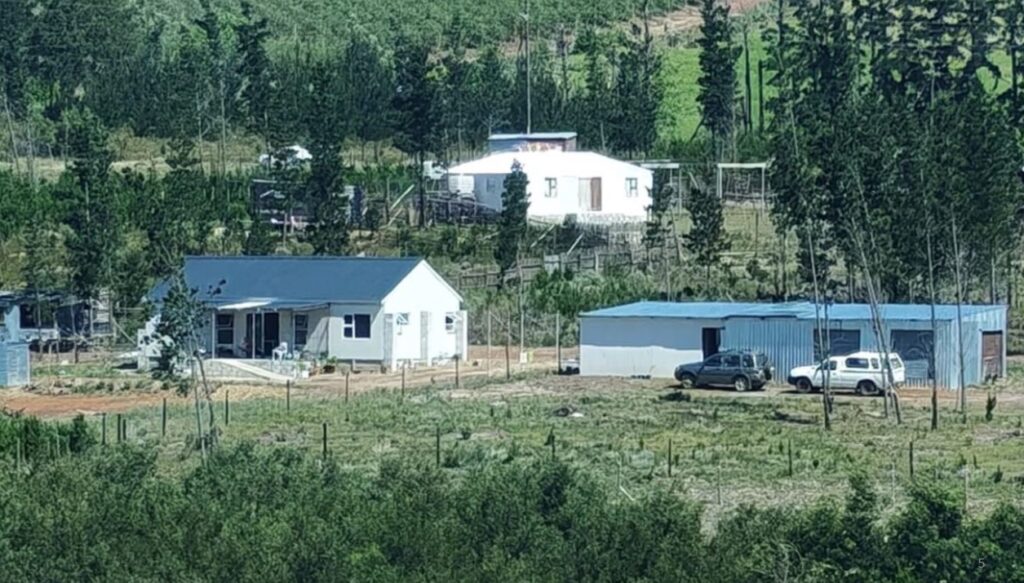
The unlawful occupation of about 2 000 hectares of state-owned land at Knoflokskraal near Grabouw in the Western Cape is heading back to court as the government seeks a lasting solution.
Some of the land is allegedly being used for second homes, holiday properties listed on Airbnb, and restaurants.
Read:
State property shake-up starting to take form
Illegal land grabs prompt a rethink of the Pie Act
Minister of Public Works and Infrastructure Dean Macpherson said on Monday that the occupation of six state-owned farms under the custodianship of the Department of Public Works and Infrastructure (DPWI) is “a very serious thing”.
“We [the government] have said that no individual has the right to claim state land, state property, whatever that may be, as their own.
“That is why we are consistent that where unlawful occupation takes place, we go to court.
“We have a number of court cases that we are currently involved in at the moment, so this is not about picking on anyone or isolating Knoflokskraal,” said Macpherson.
“This is part of a government strategy that we have at Public Works: we must reclaim our assets and put them to productive use,” he said.
Macpherson said the DPWI will be approaching the court with a comprehensive record of events at Knoflokskraal, the steps government has taken, where it has been unsuccessful, what investigations have subsequently uncovered, and what government believes is required to restore the rule of law.
He said the application will be submitted to the Western Cape High Court next week.
Part A seeks an order allowing the department to serve the application through various methods to ensure that all affected parties have a reasonable opportunity to receive notice of the proceedings and attend the main hearing.
The main application, Part B, comprises several related components. The first is to contain the occupation and prevent it from expanding further.
This would involve preventing new occupations, further construction, the delivery of building materials for new structures, and the unlawful sale or allocation of state land.
He stressed that containment does not mean eviction, but rather freezing the situation to prevent it from deteriorating further.
He said the other components of Part B are orders on:
- Engagement and enumeration by a social facilitator to establish who lives at Knoflokskraal, household compositions, when residents arrived, their socio-economic circumstances and any vulnerabilities, as well as any cultural or heritage claims being advanced, if any;
- Prohibiting unlawful conduct, including violence, threats, intimidation and harassment of government officials and contractors, as well as unlawful land transactions and the operation of unauthorised parallel policing structures; and
- Enforcement to require the South African Police Service (SAPS) to assist in enforcing the court’s directives and maintaining public order.
Allegations of illegal land sales, extortion
Macpherson highlighted alleged illegal activities at Knoflokskraal, including illegal land sales, intimidation, drug-related activity, violence and the possible establishment of organised criminal operations.
He said whistleblowers provided information in June alleging that an organised system had been established to subdivide state-owned land and fraudulently sell plots for about R1 500 each.
According to Macpherson, evidence was also submitted relating to payments and the structures allegedly facilitating the transactions.
A further disclosure identified individuals, including community leaders, who were allegedly involved in the fraudulent sale of state land.
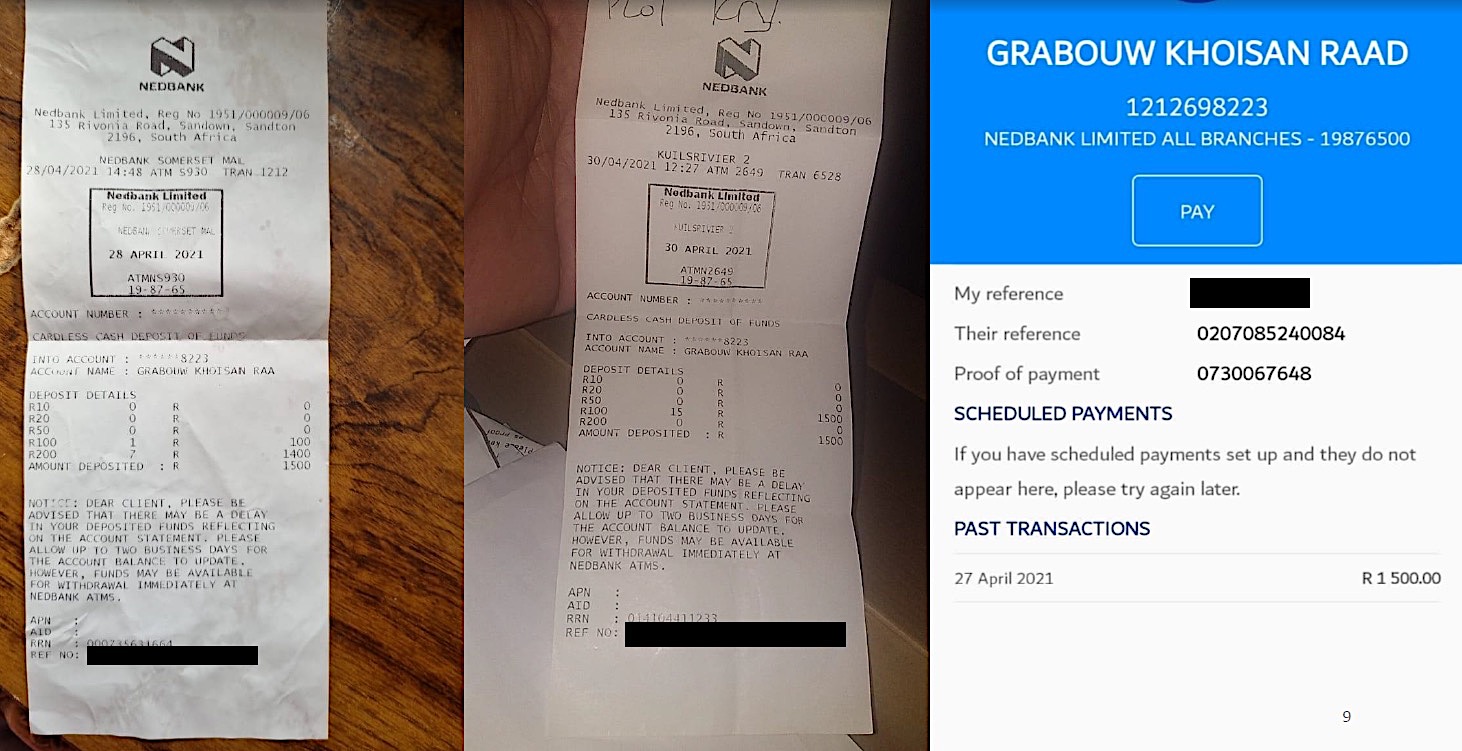
Macpherson said there were also allegations that illegal levies were being collected from residents to fund unauthorised activities and/or serve as protection fees for the unlawful allocation and subdivision of land.
He described this as extortion, which is a criminal offence.
“These allegations are now part of the evidence that has been handed to law enforcement,” he said.
Read/listen:
Is the ‘construction mafia’ battle being won?
Government bets R155bn property portfolio can fund growth
State blacklists 52 companies in long-overdue procurement crackdown
Macpherson said government has also received information about an unauthorised parallel policing structure at Knoflokskraal, which allegedly sought to exercise powers reserved for the SAPS.
He said there were further allegations of organised ranks and enforcement activities, including, alarmingly, paramilitary-style training facilities.
Macpherson said he submitted a formal criminal complaint affidavit to the SAPS in July, documenting the serious allegations.
He noted that the Knoflokskraal land was historically intended for forestry to promote job creation and economic development. It remains strategic government property intended to support forestry, investment and employment in the region.
The land was unlawfully occupied during the Covid-19 lockdown in late 2020.
He said what began as a relatively small occupation expanded rapidly, despite the government obtaining court orders in 2021 to contain the occupation of three of the properties. These orders remain in force.
Occupation keeps growing
Macpherson said the number of structures at Knoflokskraal increased from about 382 in May 2021 to 3 800 by February 2022, and about4 880 by August 2022.
“These are not small one-bedroomed houses. These are three- and four-bedroom double-storey houses with beautiful finishes in them.”
These are people with substantial amounts of money that are placing those properties there, he added.
“In fact, the one time, the N2 was closed down by 600 SUVs when there were enforcement operations taking place, which is an extraordinary situation.”
Macpherson said national, provincial and local government had engaged during this period in an attempt to resolve the matter. These efforts included court orders and attempts to contain the occupation, all of which he said had been ignored.
Millions spent on security
He said the DPWI incurred more than R58 million in private tactical security costs associated with the site between April 2021 and June 2026, which had to be taken from the department’s baseline and other service delivery programmes.
A further R5.47 million was spent on sheriff’s fees for enumerating residents and serving the various court orders obtained.
“These are enormous amounts of public money.
“They demonstrate the consequences of allowing a situation to continue without a sustainable resolution, as well as the costs associated with ignoring the rule of law.”
This “cannot become the permanent model of governance at Knoflokskraal”.
Comprehensive court application
Macpherson said his department has spent six months preparing a comprehensive court application, comprising 1 200 pages.
“This has not been easy, but it was necessary because we cannot simply surrender state-owned land to unlawful occupation,” he said.
“We cannot allow vulnerable people to be exploited through the illegal sale of land.
“We cannot allow intimidation to prevent officials from doing their jobs because allowing the rule of law to be broken is not something we can ever agree to.”
-
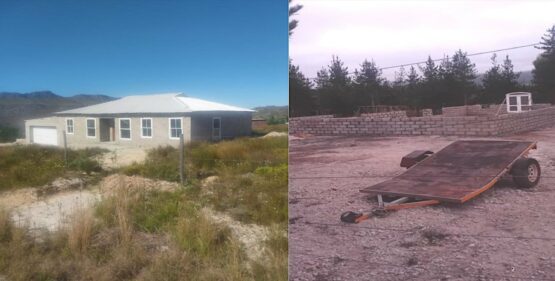
Presence of brick-and-mortar structures and building activity on the site.
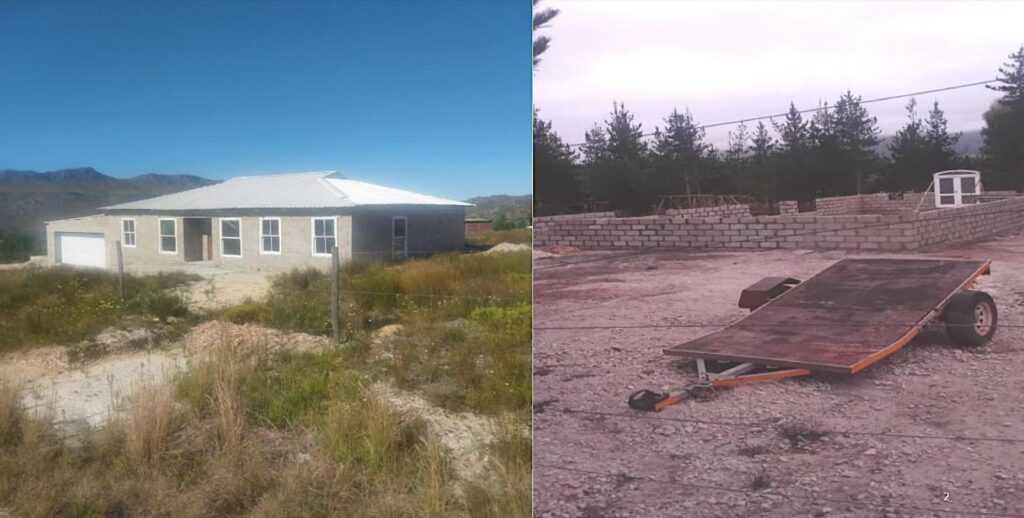
Images: From Legal update on unlawful land occupation in Western Cape presentation by the Department of Public Works and Infrastructure, Western Cape Government and Theewaterskloof Local Municipality, 12 October 2026
Macpherson said the DPWI’s responsibility is not simply to enforce the law, but also to understand the circumstances of those living at Knoflokskraal, identify vulnerable people, establish the facts and ensure that any eventual outcome was lawful, fair and constitutionally defensible.
He said the immediate priority is to stop the occupation from expanding, after which affected parties would have an opportunity to present their cases in court.
The court would then determine the way forward.