eThekwini loses appeal over raw sewage spills

The eThekwini Metropolitan Municipality has lost its appeal against a high court order requiring it to comply with legally binding directives to address untreated sewage leaks, publish weekly E. coli readings for the city’s swimming beaches, and develop an action plan to address failing wastewater treatment plants.
A full bench of the Pietermaritzburg High Court ruled on 30 September that eThekwini had no reasonable prospects of success in its appeal against the December judgment.
In the initial judgment, the high court ordered eThekwini to:
- Set out how it intends to comply with seven legally binding compliance notices and directives addressing inadequate wastewater treatment;
- Publish weekly E. coli readings for swimming beaches, including on its social media platforms;
- Obtain the necessary authorisations for 10 wastewater treatment works operating without water-use licences, which is unlawful; and
- Develop a detailed action plan, with time frames, to address challenges affecting its wastewater treatment infrastructure.
“The city has been complying with the December judgment,” said municipality spokesperson Senzelwe Mzila, adding that it had “only been appealing certain aspects of it”.
He said eThekwini is still studying Wednesday’s judgment and that the municipality is already publishing E. coli readings on beach water quality on its website.
Read:
Financial alarm bells ring across seven of SA’s eight metros
Raw sewage is flowing in nearly every metro
Durban coastline: Sewage-polluted beaches pose threat to holidaymakers and the environment
But Dean Macpherson, provincial chair of the Democratic Alliance (DA) in KwaZulu-Natal (KZN) – who is also Minister of Public Works and Infrastructure – said the municipality’s decision to appeal the judgment means it was not complying with the order.
Legal action
The legal action began when the DA, and ActionSA in a separate application, took eThekwini to court to force it to comply with legally binding directives on water and sewage management issued by the KZN Department of Economic Development, Tourism and Environmental Affairs and the KZN Department of Water and Sanitation.
The directives, issued in 2021 and 2022, ordered the municipality to address raw sewage spills into rivers and residential areas.
In its initial court papers, the DA complained that “eThekwini has persistently failed to adequately maintain and operate its wastewater treatment works throughout its jurisdiction”.
“This has resulted in repeated and continued large-scale sewage spillage into rivers, tributaries and water bodies which run into the ocean.”
The DA also said eThekwini had failed to adequately inform the public about the severity of the crisis and how it intended to address it.
It raised concerns that sewage spills at beaches posed a risk to residents’ health and could damage tourism and business growth in the city.
Service delivery at municipalities has been under the spotlight ahead of November’s local government elections.
Read/watch:
The Ballot Sheet with Ray Mahlaka: Why we’re doing this
Mashaba: ‘I have unfinished business in Joburg’
Complying with directives
In December 2025, the Pietermaritzburg High Court ruled that eThekwini had breached the National Environmental Management Act, the National Water Act, the National Environmental Management: Integrated Coastal Management Act, the National Environmental Management: Waste Act and Section 24 of the Constitution, which provides for everyone’s right to an environment that is not harmful to their health or wellbeing.
On Wednesday, a full bench of the KwaZulu-Natal High Court, including Judge President Thoba Poyo-Dlwati, found that the municipality had no prospects of success in its attempt to appeal the December judgment.
The municipality had argued that one reason it should be allowed to appeal was that the court had not considered whether it had taken reasonable steps to comply with the legal directives to repair its wastewater treatment works and prevent sewage spills.
The DA argued the directives were clear legal orders with time frames and there was either compliance or not.
Even eThekwini’s lawyers admitted the municipality had not complied with the directives.
The full bench also found that it was “axiomatic” that the municipality had not taken reasonable measures to address the reported water quality problems.
“The failure of the applicant to take reasonable steps to safeguard water resources, public rivers, beaches, and residents’ homes are issues that have affected the citizenry for many years and do not require further investigation.”
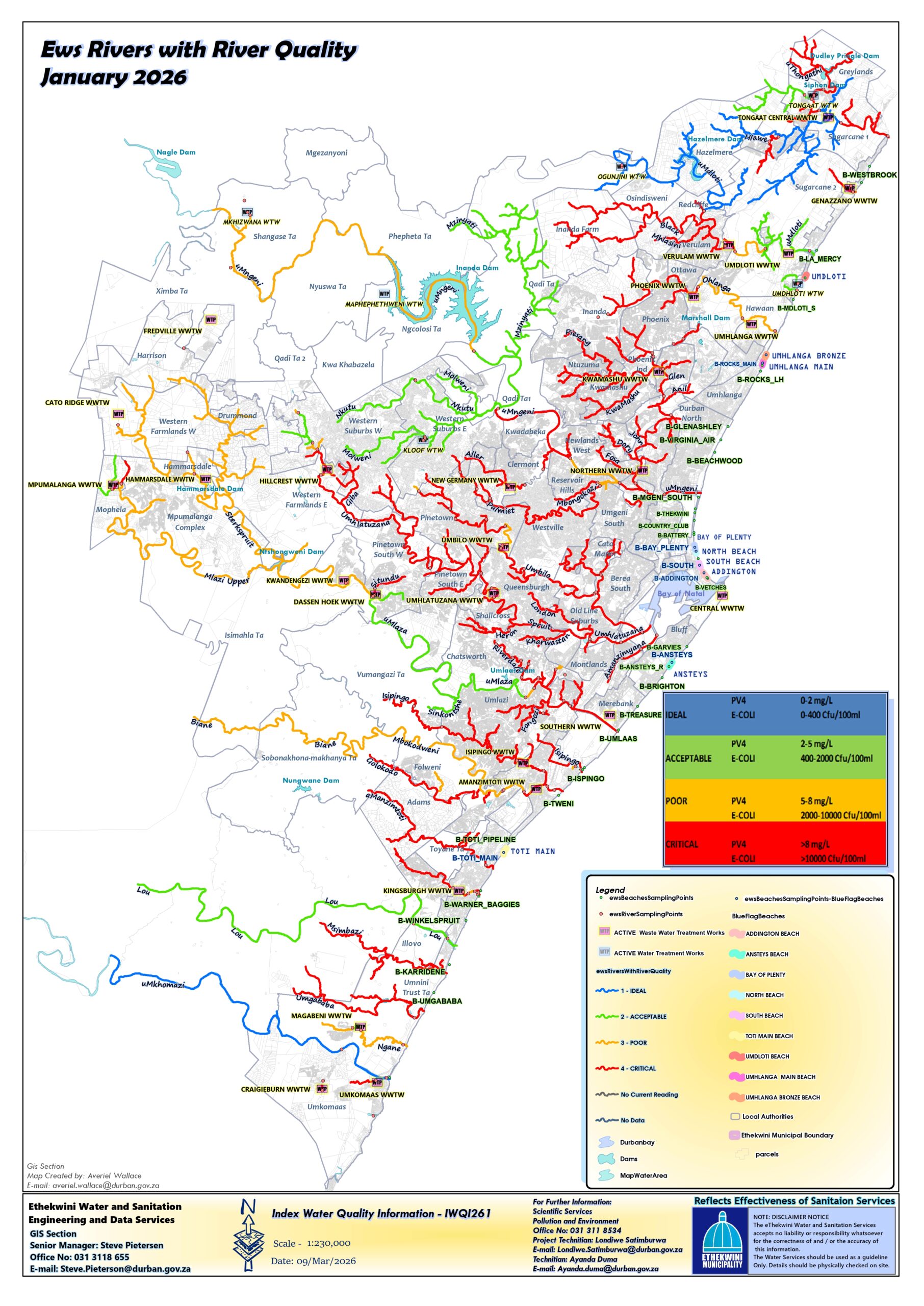
The judgment also found that eThekwini had admitted it did not have water-use licences for some of its wastewater treatment works.
The municipality argued that some of the problems affecting its wastewater infrastructure had been caused by the 2022 floods and vandalism.
However, the judgment noted that “the information contained in the notices reveals that many of the reported issues began long before the floods in April 2022 and remained unresolved at the hearing of the application on 24 and 25 July 2025, persisting for a span of five to seven years”.
No factual basis for an appeal
The municipality also argued that its version of the facts had not been properly considered, giving it grounds for an appeal.
However, the court found that there was an absence of a factual disagreement as the non-compliance with the notices [to address sewage spills] was not in dispute.
eThekwini had argued that its infrastructure was designed to serve a much smaller population and that, following the expansion of the municipal boundaries in 2000, it suddenly had to provide services to about four million residents using outdated systems.
Read/listen:
Warnings grow as SA’s water infrastructure nears breaking point
Amnesty International warns SA government’s climate failures are drowning the poor
The court rejected the municipality’s argument that financial constraints prevented it from complying with the directives, noting that eThekwini had provided no budget data to support the defence.
Macpherson said: “The irony is the municipality has spent millions on lawyers, instead of fixing the water problems.”